
Larry S. Liebovitch, Ph.D.
Professor
Department of Physics and
Department of Psychology
Dean of the Division of Mathematics and Natural Sciences 2010-2013
Accomplishmenrts
as Dean
Queens College, City University of New York
65-30 Kissena Boulevard
Physics Department
Science Building
Room B322
Flushing, NY 11367
Telephone: 718.997.3390
email:larry.liebovitch@qc.cuny.edu
|
 |
B.S.
Physics, City College of New York, 1972
Ph.D. Astronomy, Harvard University, 1978
In
1995, elected as a Fellow of the American Physical Society
"For advancing the physics of fractals and chaos and using
these methods to analyze and understand biological systems." |
Curriculum
Vitae
Resume
Portfolio of Work
|
COURSE: Introduction to Hardware & Algorithms of Quantum Computing:
PHYSICS 85200-03, January 31, 2020 - May 22, 2020, Fridays 2:00 PM - 4:00 PM.
The City University of New York Graduate Center, 365 Fifth Avenue, Room 4419,
Course information, lecture videos, powerpoint slides, homework and other stuff is available at:
https://drive.google.com/drive/folders/1_LkxHM1pISb8-LCyHRvtDNDDiYw2-cf7?usp=sharing |
SELECTED RECENT PUBLICATIONS: 2018-2020
| article: P. T. Coleman, J. Fisher, D. P. Fry, L. S. Liebovitch, A. Chen-Carrel, and G. Souillac. 2020. How to live in peace? Mapping the science of sustaining peace: A progress report. APA American Psychologist, Advance online publication.https://psycnet.apa.org/doiLanding?doi=10.1037%2Famp0000745. |
| article: L. S. Liebovitch, P. T. Coleman, A. Bechhofer, C. Colon, J. Donahue, C. Eisenbach, L. Guzman-Vargas, D. Jacobs, A. Khan, C. Li, D. Maksumov, J. Mucia, M. Persaud, M. Salimi, L. Schweiger, and Q. Wang. 2019. Complexity analysis of sustainable peace: mathematical models and data science measurements. New Journal of Physics, Published 8 July 2019. https://iopscience.iop.org/article/10.1088/1367-2630/ab2a96. |
| book: U. Strawinska-Zanko and L. S. Liebovitch, Eds. 2018, Mathematical Modeling of Social Relationships, Springer Series in Computational Social Sciences Springer: New York, ISBN 978-3-319-76765-9 |
VIDEOS
|
Courses, Webinars, Conference Presentations
|
Video of Presentation: A Basic Introduction to Quantum Computing: Hardware, Software, and Applications, January 16, 2020
New York Quantum Computing Meetup, Microsoft, New York, NY.
video: URL link:click here powerpoint:
URL link:click here
Also presented:
January 23, 2019: New York Quantum Computing Meetup, Tata Innovation Center, New York, NY.
November 16, 2018: I-SENSE Seminar Series, Florida Atlantic University, Boca Raton, FL.
October 15, 2018: Physics Department, Queens College, City University of New York, Flushing, NY.
|
Video of Seminar: What We Know and Don't Know About Complex Systems, November 13, 2018
Faculty Seminar on Complexity Science, Modeling and Sustainability, Columbia University.
URL link:click here
|
Video of Colloquium: Mathematical Models and Data Science of Sustainable Peace, March 20, 2018
Peace, Justice and Human Rights (PJHR) Initiative Colloquium, Florida Atlantic University.
URL link:click here
|
Video of Conference Presentation: Dynamics of Sustainable Peace: A Mathematical Model, October 26, 2017
2017 Conference of the Peace and Justice Study Association.
URL link:click here
|
Video of Course Lectures: Physics for Computer Science II - Undergraduate Physics PH 204, Spring 2017
Networks, statistical physics, chaos, electricity & magnetism, electric circuits, quantum mechanics, encryption, quantum cryptography, quantum computing, quantum atoms, quantum materials
YouTube: Smart Physics for Brilliant Computer Engineers - Season 2
URL link:click here
|
Video of Lecture: Using Methods from Physics to Study Social Systems, July 25, 2017
16th Annual Queens College, City University of New York, Summer Science Program for High School Students.
URL link:click here
|
Video of Conference Presentation: Mathematical Models
of the Sustainable Peace Map, September 28, 2016
Queens College City University of New York Undergraduate Research Opportunities Showcase.
URL link:click here
|
Video of Conference Presentation: Mathematics of Human Behavior, March 26, 2015
Columbia University Teachers College: Sustainable Peace: Systems, Applications and Interventions, The Advanced Consortium on Cooperation, Conflict and Complexity (AC4).
URL link:click here
|
Peter T. Coleman Interviews: Larry Liebovitch, December 7, 2014
WKCR-FM Columbia University.
URL link:click here
|
Webinar: What Mathematical Models Can Tell Us About Human Behavior, October 14, 2014
Human Systems Dynamics Institute - Systems and Peace: Emerging Frontiers.
URL link:click here
|
Methods in Complex Systems: An undergraduate/graduate course in statistics, non-parametric statistics, and complex systems (fractals, chaos, and nonlinear dynamics) at Florida Atlantic University, Spring 1998.
URL link:click here
|
BOOKS
|
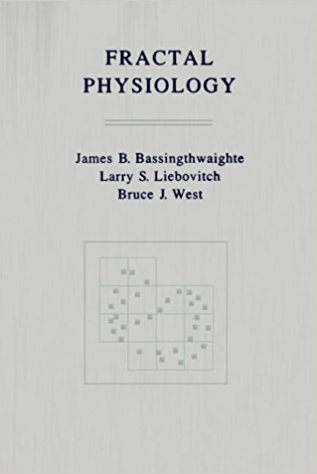
Oxford
University Press
Fractal Physiology |
Fractal Physiology: American Physiology Society, Methods in Physiology Series, Volume 2
by
- James B. Bassingthwaighte
- Larry S. Liebovitch
- Bruce J. West
- 1994
- Oxford University Press, New York NY, 10016
- ISBN 0195080130
- This book describes the properties of fractal patterns and measures and how they can be used to gain a better understanding of biology, particularly human physiology.
|
|
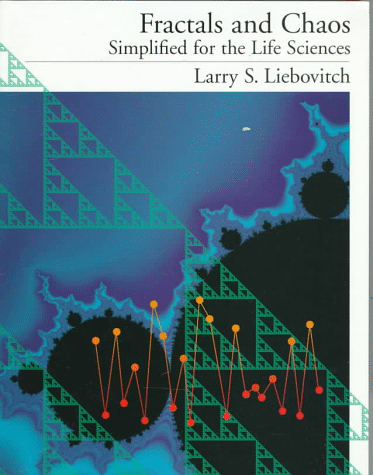
Oxford
University Press
Fractals and Chaos Simplified |
Fractals and Chaos Simplified for the Life
Sciences
- by Larry S. Liebovitch, 1998
- Oxford University Press, New York NY, 10016
- ISBN 0-19-512024-8
- This book explains the properties of fractals and chaos and illustrates
them with examples from biology and medicine. The aim is to provide
a basic understanding to people who are unfamiliar and/or afraid
of mathematics. However, enough mathematical detail is provided
so that biomedical scientists can learn how to use these new
methods in their own research. The material is presented one
concept at at time on facing pages, with text on the left page and
graphics on the right page. The graphics pages can be copied onto
transparencies to use to teach this material.
|
|
SAGE Publications, Quantitative Applications in the Social Sciences,
Volume 165
SAGE:
QASS Vol. 165 |
Fractal Analysis in the Social Sciences
- by Clifford T. Brown and Larry S. Liebovitch, 2010
- SAGE Publications, Thousand Oaks, CA, 91320
- ISBN: 9781412971652
- This primer uses straightforward language to give the reader step-by-step
instructions for identifying and analyzing fractal patterns and
the social process that create them. By making fractals
accessible to the social science students, this book has a
significant impact on the understanding of human behavior.
- Detailed examples help readers learn and understand the analytical methods
presented.
- Clear and logical explanations of fractals and their analysis enable the
instructor to easily teach and the student to easily learn the
material.
- MATLAB programs
to analyze data.
|
|
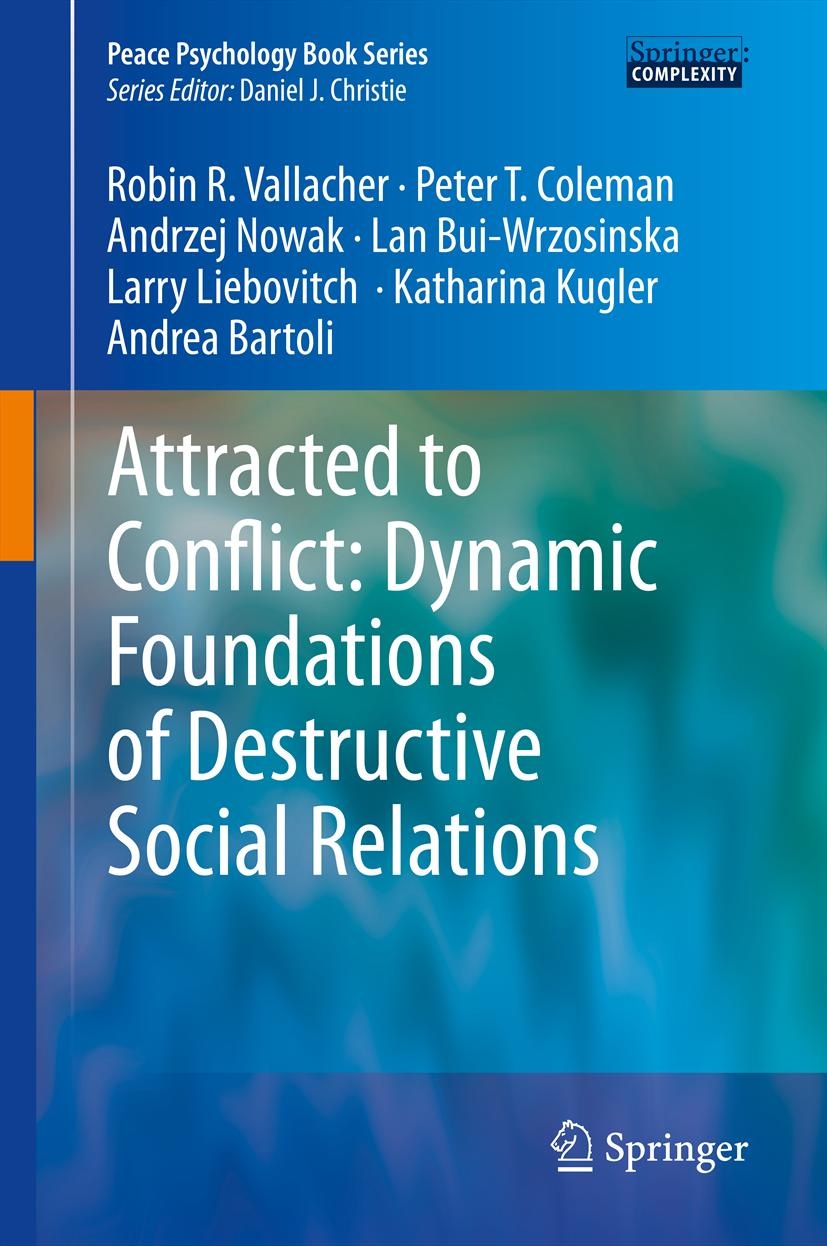
Springer, Peace Psychology Book Series
Attracted
to Conflict |
Attracted to Conflict: Dynamic Foundations
of Destructive Social Relations by
- R. R. Vallacher
- P. T. Coleman
- A. Nowak
- L. Bui-Wrzosinska
- L. Liebovitch
- K. Kugler
- A. Bartoli,
2013
- Springer, New York, NY, 10013
- ISBN: 978-3-642-35279-9
- Addresses intractable social conflict from the new vantage point of
dynamical systems.
- Authored by leading researchers in the field with different relevant
backgrounds.
- Addresses a broad audience of researchers in the natural sciences and
humanities.
|
|

Springer Series in Computational Social Science
Mathematical Modeling of Social Relationships |
Mathematical Modeling of Social Relationships Edited by
- Urszula Strawinska-Zanko
- Larry S. Liebovitch,
2018
- Springer, New York, NY, 10013
- ISBN: 978-3-319-76765-9
- Research studies that use new methods of quantitative analysis and mathematical modeling to understand social processes.
- For students and researchers in a broad area of fields including social psychology, complex systems, and applied mathematics.
|
JOURNAL ARTICLES
complete list in curriculum
vitae
|
BIOLOGY: differentiation, gene expression, ion channels
|
L. S. Liebovitch and V. Naudot. 2011.
Open problems in the
dynamics of the expression of gene interaction networks (pdf), In Frontiers
in the Study of Chaotic Dynamical Systems with Open Problems, Ed. Z. Elhadj and
J. C. Sprott, World Scientific, Singapore, pp. 219-229. |
J. L. Michaels, V. Naudot, and L. S. Liebovitch. 2010.
Dynamic
stabilization in the PU1-GATA1 circuit using a model with time-dependent kinetic
change Bulletin of Mathematical Biology doi:
10.1007/s11538-010-9615-3 |
C. Marr, F. J. Theis, L. S. Liebovitch, and M.-T. Huett. 2010.
Patterns
of subnet usage reveal distinct scales of regulation in the transcriptional
regulatory network of Escherichia coli (pdf) PLoS Computational
Biology 6(7): e1000836. doi:10.1371/journal.pcbi.1000836 |
L. S. Liebovitch, V. K. Jirsa, and L. A. Shehadeh. 2006.
Structure of
genetic regulatory networks: Evidence for scale free networks (pdf).
In Complexus Mundi: Emergent Patterns in Nature, Ed.
M. M. Novak, World Scientific, Singapore, pp. 1-8. |
L. A. Shehadeh, L. S. Liebovitch, and V. K. Jirsa. 2006.
Relationship between
global structures of genetic networks and mRNA levels measured by
cDNA microarrays (pdf).Physica A 364
:297-314. |
L. S. Liebovitch and Piotr Krekora. 2002.
The physical basis of
ion channel kinetics: the importance of dynamics. Institute
for Mathematics and its Applications Volumes in Mathematics and its
Applications, Membrane Transport and Renal Physiology,Eds. H. E. Layton
and A. M. Weinstein, 129:27-52. (html) |
L. S. Liebovitch, Daniela Scheurle, Marian Rusek, and Michal Zochowski.
2001.
Fractal
methods to analyze ion channel kinetics. Methods
24:359-375 (pdf). |
W. A. Varanda, L. S. Liebovitch, J. N. Figueira, and R. A. Nogueira.
2000.
Hurst analysis
applied to the study of single calcium-activated potassium channel kinetics in
Leydig cells. J. Theoret. Biol., 206: 343-353. (pdf) . |
L. S. Liebovitch and A. T. Todorov. 2000.
What causes ion channel proteins to open and close? In Disorder Versus
Order in Brain Function, Eds. Peter Arhem, Clas
Blomberg, and Hans Liljenstrom, World Scientific, River Edge, NJ,
pp. 83-106. |
S. B. Lowen, L. S. Liebovitch, and J. A. White. 1999.
Fractal ion-channel
behavior generates fractal firing patterns in neuronal models.
Phys. Rev E, 59: 5970-5980 (pdf) |
L. S. Liebovitch, Y. Tao, A. T. Todorov, and L. Levine. 1996.
Is there an error
checking code in the base sequence in DNA? Biophysical Journal,
71:1539-1544 (pdf).. |
|
MEDICINE: drug interactions, eyes, heart attacks
|
L. S. Liebovitch, N. Tsinoremas, and A. Pandya. 2007.
Devloping
combinatorial multi-component therapies (CMCT) of drugs that are more
specific and have fewer side effects than traditional one drug
therapies (pdf) Nonlinear Biomedical Physics 1:11 (30
August) doi:10.1186/1753-4631-1-1107. |
L. S. Liebovitch. 2006.
Why the eye is
round. in Biology of the Eye, Ed. J. Fischbarg.
Elsevier, New York, NY, pp. 1-19. |
L. S. Liebovitch, T. Penzel, and J. W. Kantelhardt. 2002.
Physiological relevance of scaling of heart phenomena. In The Science of
Fractal Disasters: Climate Disruptions, Heart Attacks, and Market
Crashes, Eds. A. Bunde, J, Kropp, and H. J. Schellnhuber,
Springer, Berlin, pp. 258-281. |
L. A. Shehadeh, L. S. Liebovitch, and M. A. Wood. 2002.
Temporal patterns of atrial arrhythmia recurrences in patients with
implantable debfibrillators: implications for assessing
antiarrhythmic therapies. J. Card. Electrophys.13:303-309. |
M. A. Wood, K. A. Ellenbogen and L. S. Liebovitch. 1999.
Electrical storm in patients with transverse implantable
cardioverter-defibrillatorsJ. Am. Coll. Cardiology,
34:950-951. |
L. S. Liebovitch, A. T. Todorov, M. Zochowski, D. Scheurle, L. Colgin, M.
A. Wood, K. A. Ellenbogen, J. M. Herre, and R. C. Bernstein. 1999.
Nonlinear
properties of cardiac rhythm abnormalities. Phys. Rev E,
59:3312-3319. (pdf) |
|
PEOPLE: anthropology, buildings, conflicts, economics, peace
|
| P. T. Coleman, J. Fisher, D. P. Fry, L. S. Liebovitch, A. Chen-Carrel, and G. Souillac. 2020. How to live in peace? Mapping the science of sustaining peace: A progress report. APA American Psychologist, Advance online publication.https://psycnet.apa.org/doiLanding?doi=10.1037%2Famp0000745. |
| L. S. Liebovitch, P. T. Coleman, A. Bechhofer, C. Colon, J. Donahue, C. Eisenbach, L. Guzman-Vargas, D. Jacobs, A. Khan, C. Li, D. Maksumov, J. Mucia, M. Persaud, M. Salimi, L. Schweiger, and Q. Wang. 2019. Complexity analysis of sustainable peace: mathematical models and data science measurements. New Journal of Physics, Published 8 July 2019. https://iopscience.iop.org/article/10.1088/1367-2630/ab2a96. |
| L. S. Liebovitch, P. T. Coleman, and J. Fisher. 2019. Approaches to understanding sustainable Peace: Qualitative causal loop diagrams and quantitative mathematical models. American Behavioral Scientist, Published July 4, 2019. https://journals.sagepub.com/eprint/RBBHYSEM8G6SWMNG5ZNY/full. |
| P. T. Coleman, L. S. Liebovitch, and J. Fisher. 2019. Taking complex systems seriously: Visualizing and modeling the dynamics of sustainable peace. Global Policy. 02 June 2019 https://doi.org/10.1111/1758-5899.12680. |
H. Knowles III, M. E. Hostetler, and L. S. Liebovitch. 2017.
Describing the dynamics, distributions, and multiscale relationships in the time evolution of residential building energy consumption. Energy and Buildings https://doi.org/10.1016/j.enbuild.2017.09.071 |
L. Guzman-Vargas, B. Obregon-Quintana, D. Aguilar-Velazquez, R. Hernandez-Perez, and L. S. Liebovitch. 2015.
Word-Length Correlations and Memory in Large Texts: A Visibility Network Analysis (pdf). Entropy 17:7798-7810; doi:10.3390/e17117798 |
L. S. Liebovitch, P. T. Coleman, B. Fisher-Yoshida, J. Fisher, K. Mazzaro, D. Fry, P. Vandenbroeck, and S. Ortiz. 2015.
Challenge Problem: Sustainable Peace (pdf). Bloomberg Data for Good Exchange |
I Y. Fernandez-Rosales, L. S. Liebovitch, L. Guzman-Vargas. 2015.
The dynamic consequences of cooperation and competition in small-world networks. PLOS ONEPublished: April 30, 2015 DOI: 10.1371/journal.pone.0126234 |
L. Kurt, K. G. Kugler, P. T. Coleman, and L. S. Liebovitch. 2014.
Behavioral and emotional dynamics of two people struggling to reach a consensus
about a topic on which they disagree. PLOS ONEPublished: January 10, 2014 DOI: 10.1371/journal.pone.008460 |
J. L. Michaels, R. R. Vallacher, and L. S. Liebovitch. 2013.
Volatile psychological dynamics
in social interactions: Attitudes and emotions react asymmetrically to interaction shifts between agreement and disagreement (pdf)
Social Psychology and Personality Science 4:705-713. DOI: 10.1177/1948550613482985 |
A. Rojas-Pachecoa, B. Obregon-Quintanab, L.S. Liebovitch, and L.
Guzman-Vargasa. 2013.
Time-delay
effects on dynamics of a two-actor conflict model. Physica A392:458-467,
doi: dx.doi.org/10.1016/j.physa.2012.09.021 |
R. Peluso, L. S. Liebovitch, J. M, Gottman, and J. Su. 2012.
A
Mathematical Model of Psychotherapy: An Investigation Using Dynamic Non-linear
Equations to Model the Therapeutic Relationship. Psychotherapy Research
22(1):40-55, doi: 10.1080/10503307.2011.622314 |
L. S. Liebovitch, Paul R. Peluso, M. D. Norman, J. Su, and J. M. Gottman.
2011.
Mathematical
model of the dynamics of psychotherapy. Cognitive Neurodynamicsdoi:
10.1007/s11571-011-9157-x |
L. S. Liebovitch, R. Vallacher, and J. Michaels. 2010.
Dynamics of cooperation-competition interaction model, Peace and Conflict:
The Journal of Peace Psychology, 16(2):175-188. |
N. E. Romero, Q. D. Y. Ma, L. S. Liebovitch, C. T. Brown and P.
Ch. Ivanov. 2010.
Correlated walks down the
Babylonian markets (pdf) Europhysics Letters (EPL) 90:18004. doi:
10.1209/0295-5075/90/18004. |
L. S. Liebovitch, V. Naudot, R. Vallacher, A. Nowak, L. Bui-Wrzosinska, and
P. Coleman. 2008.
Dynamics of
two-actor cooperation-competition conflict models. (pdf) Physica
A 387:6360-6378.
doi:
10.1016/j.physa.2008.07.020 |
| C. T. Brown, L. S. Liebovitch, and R. Glendon. 2007.
Levy flights in Dobe
Ju/'hoansi foraging patterns (pdf). Human Ecology
35:129-138. |
L. S. Liebovitch and Lina A. Shehadeh. 2005.
Chapter 5. Introduction
to Fractals (pdf). In Tutorials in Contemporary Nonlinear
Methods for the Behavorial Sciences Web Book Eds. M. A. Riley
and G. V. Orden, National Science Foundation, Directorate for
Social, Behavorial and Economic Sciences,
http://www.nsf.gov/sbe/bcs/pac/nmbs/nmbs.jsp |
C. T. Brown, W. R. T. Walter, and L. S. Liebovitch. 2005.
The Broken Past: Fractals
in Archaeology. J. Archaeological Method and Theory
12 :37-78. (pdf). |
|
PHYSICS: complexity, networks, oscillators
|
| E. Baeza-Blancas, B. Obregon-Quintana, C. Hernandez-Gomez, D. Gomez-Melendez, D. Aguilar-Velazquez, L. S. Liebovitch, and L. Guzman-Vargas. 2019. Recurrence networks in natural languages. Entropy 21(5), 517; https://doi.org/10.3390/e21050517. |
I Y. Fernandez-Rosales, L. S. Liebovitch, L. Guzman-Vargas. 2015.
The dynamic consequences of cooperation and competition in small-world networks. PLOS ONEPublished: April 30, 2015 DOI: 10.1371/journal.pone.0126234 |
C. Witkov and L. S. Liebovitch. 2010.
Predicting optimal sweep
rates for autoresonance in Duffing-type oscillators: A beat method
using Teager-Kaiser instantaneous frequency J. Sound and
Vibration 329(8):1154-1164. doi:10.1016/j.jsv.2009.10.030 |
L. S. Liebovitch. 2006.
What is "Self-Organization"?
(pdf) In Emgering, The Newsletter of the
Plexus Institute, April-August 2006, pp. 16-19. |
L. S. Liebovitch, A. T. Todorov, M. A. Wood, and K. A. Ellenbogen. 2000.
When using the mean is meaningless: examples from
probability theory and cardiology, In Handbook of Research
Design in Mathematics and Science Education Eds. A.
E. Kelly and R. Lesh, Lawrence Erlbaum Assoc. Inc, Mahwah NJ, pp.
913-926. |
L. S. Liebovitch, and D. Scheurle. 2000.
Two lessons
from fractals and chaos. Complexity,
5(No.4):34-43. (html). |
M. Zochowski and L. S. Liebovitch. 1999.
Self-organizing
dynamics of coupled map systems. Phys. Rev E, 59:2830-2837 (pdf). |
COURSES TAUGHT
complete list in curriculum
vitae
|
Queens College, City University of New York, NY
|
Physics Applications of Machine Learning and Data Science - PH 270, Fall 2020, syllabus
A practical introduction to using machine learning to analyze experimental data and theoretical models in physics, chemistry, biology, and earth sciences. Provides contemporary skills valuable for careers in technology. |
General Physics I - Undergraduate Physics PH 1214, Fall 2020, syllabus
Vectors, linear and circular motion, forces, gravity, energy, momentum, fluids, heat, and the applications of physics. |
Introduction to Hardware & Algorithms of Quantum Computing - Graduate Physics PHYS 85200-3, Spring 2020, syllabus
Theory and Use of Quantum Computers: hardware and how it works, algorithms needed to solve problems, applications in cryptography and machine learning. |
Physics for Computer Science II - Undergraduate Physics PH 204 Spring 2020, syllabus
Networks, statistical physics, chaos, electricity & magnetism, electric circuits, quantum mechanics, quantum cryptography, quantum computing, encryption, quantum atoms, quantum materials. |
General Physics I - Undergraduate Physics PH 1214, Fall 2019, syllabus
Vectors, linear and circular motion, forces, gravity, energy, momentum, fluids, heat, and the applications of physics. |
Physics for Computer Science II - Undergraduate Physics PH 204, Fall 2019, syllabus
Networks, statistical physics, chaos, electricity & magnetism, electric circuits, quantum mechanics, quantum cryptography, quantum computing, encryption, quantum atoms, quantum materials. |
General Physics II - Undergraduate Physics PH 1224, Spring 2019, syllabus
Electricity, magnetism, optics, special relativity, quantum mechanics. |
Physics for Computer Science II - Undergraduate Physics PH 204, Spring 2019, syllabus
Networks, statistical physics, chaos, electricity & magnetism, electric circuits, quantum mechanics, quantum cryptography, quantum computing, encryption, quantum atoms, quantum materials. |
General Physics I - Undergraduate Physics PH 1214, Fall 2018, syllabus
Vectors, linear and circular motion, forces, gravity, energy, momentum, fluids, heat, and the applications of physics. |
Physics for Computer Science II - Undergraduate Physics PH 204, Fall 2018, syllabus
Networks, statistical physics, chaos, electricity & magnetism, electric circuits, quantum mechanics, quantum cryptography, quantum computing, encryption, quantum atoms, quantum materials. |
General Physics I - Undergraduate Physics PH 1214, Spring 2017, syllabus
Vectors, linear and circular motion, forces, gravity, energy, momentum, fluids, heat, and the applications of physics. |
Physics for Computer Science II - Undergraduate Physics PH 204, Spring 2017, syllabus
Networks, statistical physics, chaos, electricity & magnetism, electric circuits, quantum mechanics, quantum cryptography, quantum computing, encryption, quantum atoms, quantum materials. |
Physics for Computer Science II - Undergraduate Physics PH 204, Fall 2016, syllabus
Networks, statistical physics, chaos, electricity & magnetism, electric circuits, quantum mechanics, quantum cryptography, quantum computing, fourier transforms, encryption, quantum atoms, quantum materials. |
Introduction to Modern Physics - Undergraduate Physics PH 260, Fall 2016, syllabus
Special relativity and quantum mechanics. |
General Physics II - Undergraduate Physics PH 122, Spring 2016, syllabus
Electricity, magnetism, optics, special relativity, quantum mechanics. |
| General Physics II Laboratory - Undergraduate Physics PH 122, Spring 2016 |
| Principles of Physics I Laboratory - Undergraduate Physics PH 145, Spring 2016 |
Introduction to Modern Physics - Undergraduate Physics PH 260, Fall 2015, syllabus
Special relativity and quantum mechanics. |
| General Astronomy Laboratory - Undergraduate Physics Astr 2, Fall 2015 |
| General Physics II Laboratory - Undergraduate Physics PH 122, Fall 2015 |
General Physics II - Undergraduate Physics PH 122, Spring 2015, syllabus
Electricity, magnetism, optics, special relativity, quantum mechanics. |
| General Astronomy Laboratory - Undergraduate Physics Astr 2, Spring 2015 |
Introduction to Modern Physics - Undergraduate Physics PH 260, Fall 2014, syllabus
Special relativity and quantum mechanics. |
| Principles of Physics I Laboratory - Undergraduate Physics PH 145, Fall 2014 |
| General Astronomy Laboratory - Undergraduate Physics Astr 2, Fall 2014 |
|
Florida Atlantic University, Boca Raton, FL
|
Fractals in Psychology - Undergraduate Psychology PSY 3502, Fall 2009, syllabus
How fractal methods can be used to analyze experimental data and gain a better understanding of the physiology and psychology of perception and behavior. |
Methods in Complex Systems - Graduate Interdisciplinary ISC 6450, Fall 2008, syllabus
Linear, parametric, non-parametric, and nonlinear analysis of experimental data: The stuff that they told you and that they didn't tell you in undergraduate statistics. This course helps you to understand the assumptions used in these statistical methods and which statistical methods are best for analyzing different types of data.
Required for the Ph.D. program in Complex Systems and Brain Sciences.
|
| Fractals in Psychology - Undergraduate Psychology PSY 3502, Spring 2008, syllabus |
| Application of Fractals to Psychology - Undergraduate Psychology PSY 4930. Spring 2007, syllabus
|
Complexity for the Life Sciences - Graduate Psychology PSY 5930, Fall 2006, syllabus
Most things are made up of many pieces that interact strongly with each other.
Yet much of science has tried to study things by tearing them apart and studying only their tiny separate, noninteracting pieces. Here we will learn how the science of "complexity" is able to help us see, analyze, and understand complex entities in physics, chemistry, biology, and psychology. |
Psychology and the Internet - Undergraduate Psychology PSY 4930, Spring 2006, syllabus
The INTERNET has become an important mode of how people acquire information, interact with each other, and conduct business. Thorough knowledge of the INTERNET is becoming of pivotal importance in academic Psychology and in the Business environment. This course will:
Tell you what the INTERNET is, how it works, and how it came to be.
Describe the social space and processes that happen over the INTERNET.
Describe how the Internet is changing social interactions, businesses, politics, and the military. |
The Mathematics and Science of Fractals - Undergraduate Mathematics MAT 1932, Spring 2005, syllabus
Mathematics for undergraduate students who never liked and never did well in math. |
Fractals and Chaos for the Life Sciences - Graduate Interdisciplinary ISC 5451, Fall 2004, syllabus
Mathematics of fractals and chaos applied to cellular, physiological, and psychological systems. (Mathematical level: calculus and differential equations.) |
The Mathematics and Science of Fractals - Undergraduate Mathematics MAT 1932, Spring 2004, syllabus
Mathematics for undergraduate students who never liked and never did well in math. |
| Methods in Complex Systems - Graduate Interdisciplinary ISC 6450, Spring 2004, syllabus |
Psychology of the Internet - Undergraduate Psychology PSY 4930, Fall 2003, syllabus
The INTERNET has become an important mode of how people acquire information, interact with each other, and conduct business.
Thorough knowledge of the INTERNET is becoming of pivotal importance in academic Psychology and in the Business environment. This course will:
Tell you what the INTERNET is and how it works.
Describe the social space and processes that happen over the INTERNET.
Give you information about resources available for learning about Psychology over the INTERNET. |
last revised April 4, 2021
|
|
|
|
|